Leaderboard / #1 of 13 / Driven end-to-end
Orca
Teams and solo builders on any OS who want a GUI they can also script.
Weighted feature assessment93.0range 93.0 to 93.0doc coverage 100% / Stub end-to-endmeasured: Stub run x3, launch probe
Scores by category
Rubric breakdown
Read the scores as a feature assessment. Orca was run end-to-end with stub agents; T3 Code was not run through an equivalent session, so Orca 93 vs T3 Code 90 is a difference in assessed features and evidence, not an experimentally proven gap.
- AAgent breadthweight 155
- BIsolation and parallelismweight 155
- CReview, merge and PR flowweight 154
- DRemote, cloud and mobile reachweight 105
- EOpenness and licenseweight 105
- FMaturity and momentumweight 154
- GLinux setup friction (measured)weight 105
- HPricing and BYO modelweight 55
- IDocs and transparencyweight 54
Verdict
Strengths and weaknesses
Strengths
- Headless runtime and full CLI. We drove the whole suite without a display
- Concurrent worktree creation, crash isolation, terminals that survive restarts
- 35+ agents, SSH remotes, mobile companion, MIT
Weaknesses
- About 1.1 GB peak RSS for 6 tiny sessions
- Ships several builds a day and its orchestration layer is still experimental
- 8.6k open issues+PRs, and a star count we cannot explain
Evidence
What we saw and where it came from
- Hands-on (this box)
- Fully exercised headless: 6 concurrent worktrees + stub agents, 3 logged clean runs, 6/6 verified each; crash isolation; restart persistence.
- Launch probe
- First window 4.82 s, process-tree RSS 920 MB on Xvfb.
- Lane A, 3 runs
- All 6 sessions launched in 1.52 to 1.90 s; 18/18 verified; peak RSS 1124 to 1140 MB; orca serve ready in 2.79 to 3.06 s.
- Crash and merge
- SIGKILL on one session: the other 5 stayed verified and partial work was preserved. Git merges: 5/6 clean, with t5b conflicting in shelf/config.py as designed.
- Known issues
- 8.6k open issues+PRs; ships multiple builds per day (v1.4.230), so behaviour moves fast. 'Orchestration' layer is flagged Experimental in docs.
- Notes
- GitHub reports ~97.9k stars, unusually high for a 7-month-old repo; we did not audit star provenance.
Sources
Feature facts
From docs, repos and our probes
- Platforms
- macOS, Windows, Linux (AppImage/deb/rpm), iOS + Android companion; headless `orca serve` runtime
- Supported agents
- Any terminal agent; README lists 35+ incl. Claude Code, Codex, Grok, Cursor, Copilot, OpenCode, Amp, Antigravity, Pi, Devin, Goose, Cline, Droid, Kiro, Qwen Code...
- Parallelism
- Worktree per task; fan one prompt across N agents; experimental Runs/Tasks/supervised workers (DAG) via CLI
- Isolation
- Git worktrees; SSH remote worktrees
- Review, merge, PR
- Diff review; GitHub/GitLab/Linear/Jira linking; PR/MR fields on worktrees
- Remote, cloud, mobile
- Strong: mobile companion, remote runtimes via pairing, SSH
- MCP
- Not verified (CLI + bundled agent skills are the documented control surface)
- Cost visibility
- Account/usage features exist (e.g. 'codex reset credit', 'Configure usage tracking' in UI); depth not verified
- Model choice
- --model / --effort for Claude, Codex, Cursor launches
- Setup
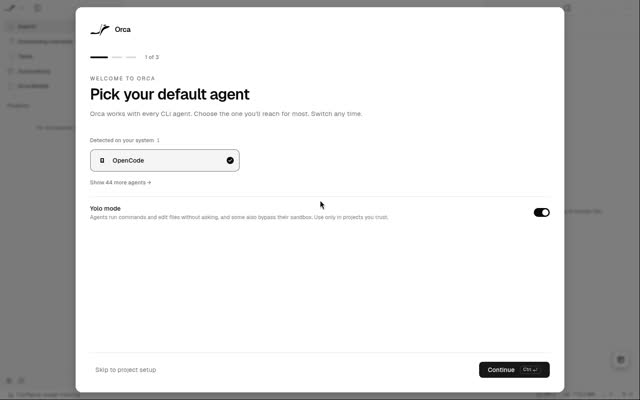
- Install app (onboarding detected OpenCode and offered 44 more agents) or `orca serve`
"unknown" means we found no source and did not guess.